Truck Driver Pay in Wisconsin (2026)
Official BLS numbers for heavy and tractor-trailer drivers (SOC 53-3032) in Wisconsin, plus what a manufacturing and food freight economy on the I-94 corridor — and a graduated income tax — do to real take-home pay.
By the HaulMath editorial team · Updated $1
Key numbers at a glance
| Metric (SOC 53-3032, statewide) | BLS OEWS, May 2025 | Typical market read (hedged) |
|---|---|---|
| Mean hourly wage | $28.31 | Close to the $28.71 national mean |
| Mean annual wage | $58,890 | vs. $59,710 nationally — about $820 behind |
| Median annual wage | $58,610 | Essentially at the national median of $58,640 |
| 10th percentile (annual) | $44,920 | A strong floor — $4,780 above the national 10th percentile |
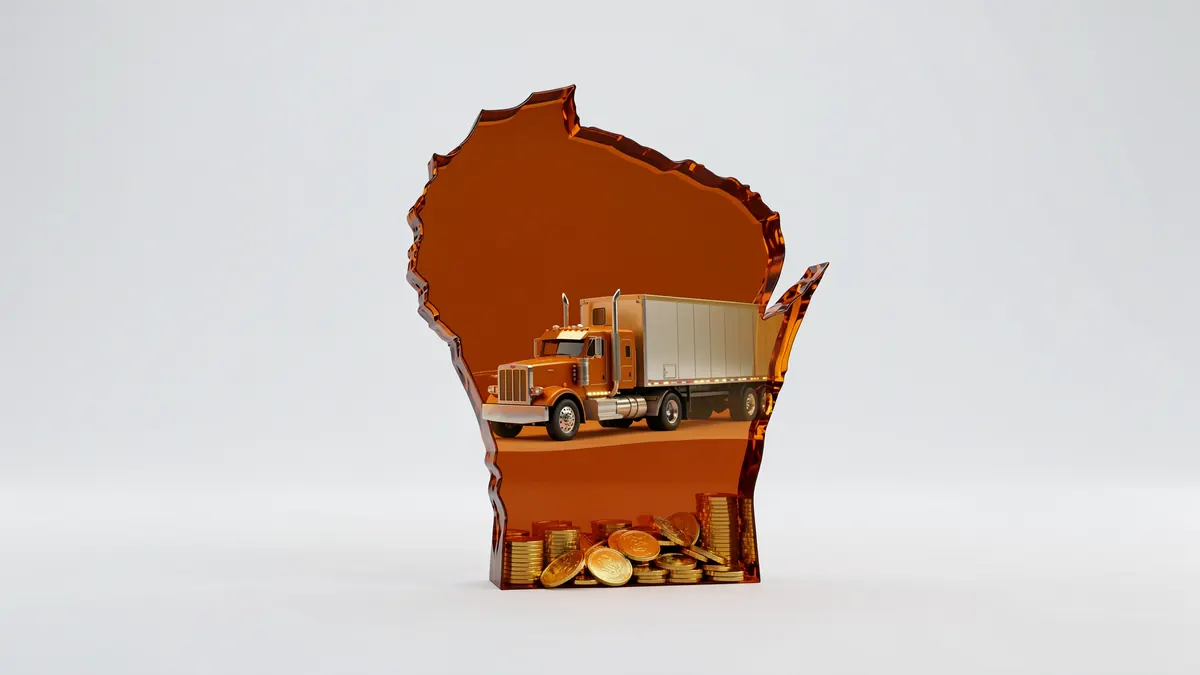
Truck driver pay in Wisconsin: the numbers
The benchmark is the Bureau of Labor Statistics OEWS survey for heavy and tractor-trailer truck drivers, May 2025 release. Wisconsin counts roughly 53,330 driver jobs — about 18.1 of every 1,000 jobs in the state, one of the heavier trucking concentrations in this series, which is what a manufacturing economy looks like in the data. Annual figures assume 2,080 hours, so treat them as full-time equivalents rather than guarantees.
| Metric (SOC 53-3032, statewide) | BLS OEWS, May 2025 | Typical market read (hedged) |
|---|---|---|
| Mean hourly wage | $28.31 | Close to the $28.71 national mean |
| Mean annual wage | $58,890 | vs. $59,710 nationally — about $820 behind |
| Median annual wage | $58,610 | Essentially at the national median of $58,640 |
| 10th percentile (annual) | $44,920 | A strong floor — $4,780 above the national 10th percentile |
| 75th percentile (annual) | $63,870 | Experienced regional and dedicated work |
| 90th percentile (annual) | $76,380 | A contained ceiling, below the national $79,380 |
| Hedged hiring range, 2026 | — | Roughly $50,000–$66,000 for experienced company drivers; verify with carriers |
Wisconsin is a high-floor, modest-ceiling market — the statistical signature of an economy with a deep base of steady manufacturing and food freight but few of the premium segments that inflate top-end wages. The 10th percentile of $44,920 means entry-level seats start nearly $4,800 above the national floor, a product of tight Upper Midwest labor markets and employers who cannot hire at trainee wages; the median sits exactly on the national median. The ceiling of $76,380 trails national, because Wisconsin's freight is inland freight — no ports, no border gateways, no oilfield — and its largest carriers are regional food, beverage and paper fleets rather than mega-carrier OTR machines. Pay mixes CPM for regional and OTR work with hourly structures in food-service, construction and local manufacturing delivery; BLS does not track CPM and offers vary — confirm specifics with the carrier.
How miles and freight shape pay in Wisconsin
Wisconsin freight is made freight — things grown, milled, processed and built in the state. The Fox Valley paper corridor from Green Bay through Appleton and Oshkosh still moves massive tonnage of paper and forest products; the food economy generates a distinctive reefer trade in cheese, butter, dairy ingredients and frozen food that fans out from plants across the state; and the Milwaukee–Madison corridor adds machinery, metal fabrication and consumer-goods manufacturing. Geographically, I-94 is the spine — the Chicago–Milwaukee–Madison–Twin Cities arc puts three major metro markets within a day's work — while I-90 and I-41 close the loop through the Fox Valley and toward Chicago's colossal distribution belt. Roughly speaking, drivers choose among regional loops to Chicago and the Twin Cities (CPM plus stop pay, often with regular customers), local food-service and manufacturing P&D (hourly, overtime after 40), and seasonal aggregates and agricultural hauls that spike with construction season and harvest. Coast-to-coast OTR exists but is usually run under national carriers' terminals in the corridor, not Wisconsin's native market.
Two seasonal notes matter for the money: winter in Wisconsin is a real operating cost — lake-effect snow, ice and shorter days slow the Chicago loops that look easy on a map — and the state's freight has a construction-and-harvest rhythm that can make October look rich and February thin. Owner-operators should run offers through the load profit calculator with seasonal fuel prices and know their true cost per mile before locking into winter lanes. For more state-by-state comparisons, see the truck driver pay by state hub.
The tax angle in Wisconsin
Wisconsin taxes wages through a graduated state income tax of 3.5% at the bottom bracket up to 7.65% at the top, with most company-driver income falling in the middle brackets — commonly an effective state rate around 4%–5% at driver incomes; verify current brackets with the Wisconsin Department of Revenue. On the $58,890 state mean, that is roughly $2,400–$2,900 a year to Madison before credits — heavier than the flat-tax states out west, and a reason Illinois-next-door comparisons depend heavily on exactly which side of the border you file from. The standard deduction and earned-income credits soften the bite for lower earners. Owner-operators still owe federal income and self-employment tax; for deduction basics that apply everywhere, see the trucking tax deductions guide.

FAQ
How much do truck drivers make in Wisconsin?
Per BLS OEWS (May 2025), heavy and tractor-trailer drivers in Wisconsin earn a mean of $28.31/hour or $58,890/year, with a median of $58,610 and a 10th–90th percentile spread of $44,920–$76,380.
Is Wisconsin pay above the national average for CDL drivers?
Roughly at it. The $58,890 mean is about $820 below the national $59,710, the median of $58,610 is essentially the national median, and the entry floor of $44,920 runs $4,780 above the national 10th percentile.
What freight moves in Wisconsin?
Paper and forest products from the Fox Valley, food and dairy including refrigerated cheese and ingredient loads, manufacturing freight off the Milwaukee–Madison–Fox Cities corridor, and heavy through-traffic on I-94 between Chicago and the Twin Cities.
Does Wisconsin tax truck driver pay?
Yes — a graduated state income tax of 3.5% to 7.65%, with most company-driver income taxed in the 4.4%–5.3% brackets. Verify current rates with the Wisconsin Department of Revenue.
Is local or OTR work more common in Wisconsin?
Regional dominates: loops to Chicago, the Twin Cities and across the Midwest anchor the market, with solid local manufacturing and food-service work in the metro corridors. Coast-to-coast OTR is usually run for national carriers.
What per-mile pay can a company driver expect in Wisconsin?
BLS does not track CPM. Company OTR and regional positions in the Upper Midwest commonly advertise roughly $0.58–$0.75 per mile; confirm current offers with the carrier.