Truck Driver Pay in Washington (2026)
Official BLS numbers for heavy and tractor-trailer drivers (SOC 53-3032) in Washington — the strongest wage market in this series — plus what Puget Sound ports, Cascade-crossing agriculture and zero state income tax do to real take-home pay.
By the HaulMath editorial team · Updated $1
Key numbers at a glance
| Metric (SOC 53-3032, statewide) | BLS OEWS, May 2025 | Typical market read (hedged) |
|---|---|---|
| Mean hourly wage | $32.80 | Far above the $28.71 national mean — $4.09 ahead |
| Mean annual wage | $68,230 | vs. $59,710 nationally — about $8,520 ahead |
| Median annual wage | $64,760 | vs. the national median of $58,640 — about $6,120 ahead |
| 10th percentile (annual) | $50,010 | An exceptionally high floor — $9,870 above the national 10th percentile |
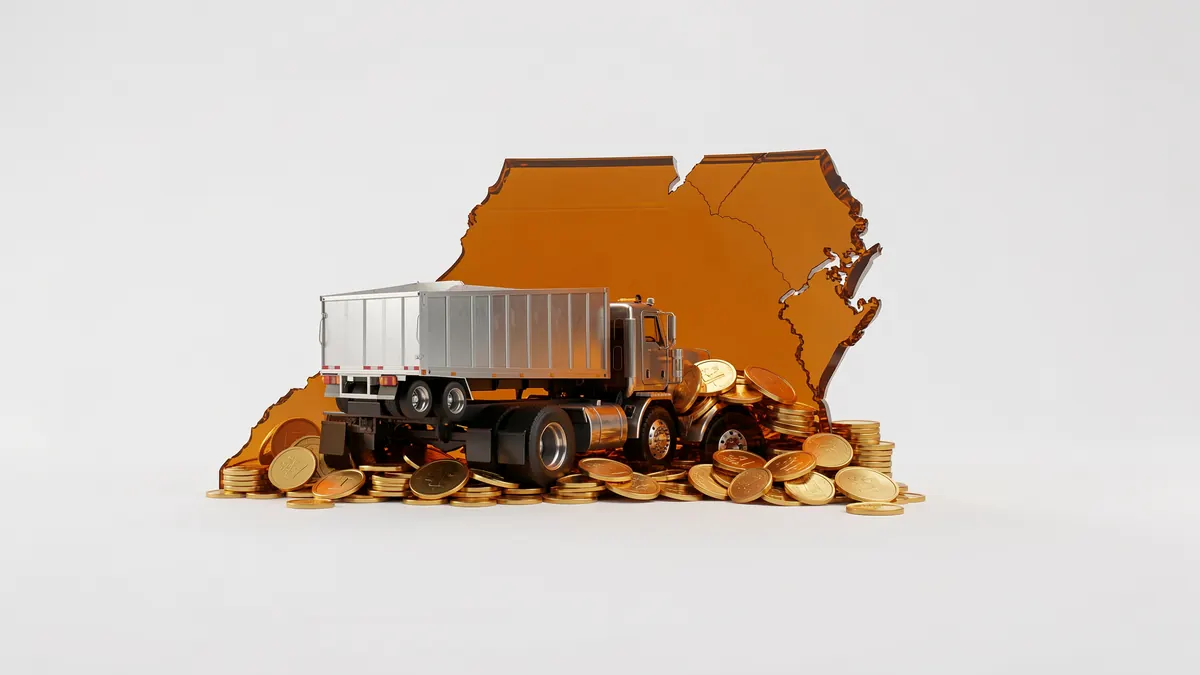
Truck driver pay in Washington: the numbers
The benchmark is the Bureau of Labor Statistics OEWS survey for heavy and tractor-trailer truck drivers, May 2025 release. Washington counts roughly 40,530 driver jobs — about 11.4 of every 1,000 jobs in the state — concentrated in the Puget Sound basin with a second pocket east of the Cascades. Annual figures assume 2,080 hours, so treat them as full-time equivalents rather than guarantees.
| Metric (SOC 53-3032, statewide) | BLS OEWS, May 2025 | Typical market read (hedged) |
|---|---|---|
| Mean hourly wage | $32.80 | Far above the $28.71 national mean — $4.09 ahead |
| Mean annual wage | $68,230 | vs. $59,710 nationally — about $8,520 ahead |
| Median annual wage | $64,760 | vs. the national median of $58,640 — about $6,120 ahead |
| 10th percentile (annual) | $50,010 | An exceptionally high floor — $9,870 above the national 10th percentile |
| 75th percentile (annual) | $75,530 | Experienced drayage, regional and specialized work |
| 90th percentile (annual) | $87,500 | Well above the national $79,380 top cut |
| Hedged hiring range, 2026 | — | Roughly $58,000–$78,000 for experienced company drivers; verify with carriers |
Washington clears the national numbers on every cut — mean, median, 10th, 75th and 90th percentile — which almost no state in this series manages. Two forces drive it. First, costs: a Puget Sound labor market that must pay warehouse-level wages far above the national norm to attract anyone cannot staff trucks cheaply, and the state's wage-floor policies lift the bottom of the market with it — hence a 10th percentile of $50,010, nearly ten thousand dollars above the national entry floor. Second, freight mix: union-adjacent port work, aerospace supply chains and high-value agricultural exports support premium seats at the top. The honest footnote is that Washington's living costs, housing in particular, absorb much of the nominal premium for drivers who live in the metro. CPM and hourly structures both are common, with strong representation of hourly-plus-overtime in local and port work; BLS does not track CPM and offers vary — confirm specifics with the carrier.
How miles and freight shape pay in Washington
The state splits at the mountains. West of the Cascades, the Puget Sound region is a Pacific gateway: the ports of Seattle and Tacoma move containers that feed a deep drayage pool around the terminals and rail yards, aerospace and advanced manufacturing around Everett generate high-value inbound and outbound freight, and the Seattle–Tacoma–Olympia corridor carries dense distribution and grocery P&D work. East of the crest is agricultural trucking at scale — apples out of Wenatchee and the Yakima Valley, potatoes, hay and hops, and food processing around the Tri-Cities and Spokane — plus timber products off the peninsula and a steady intermodal connection through the Spokane rail ramps. I-5 is the western spine; I-90 crosses the state and connects both halves to the Mountain West and Midwest. Roughly speaking, drivers choose between hourly local and drayage work in the Sound, regional loops threading the Cascades (mountain-chain requirements and real grades), and long-haul I-90/I-84 OTR to Salt Lake, Denver and Chicago.
For owner-operators, the payoffs and penalties are both oversized. Lane rates into and out of the Pacific Northwest run higher than the national picture, but so do costs: Washington's fuel taxes are among the highest in the nation, and mountain passes add wear, chains and schedule risk. Run every offer through the load profit calculator with real fuel prices, and know your true cost per mile before you commit to a lane that crosses Snoqualmie in January. For more state-by-state comparisons, see the truck driver pay by state hub.
The tax angle in Washington
Washington levies no state personal income tax on wages, per the Washington Department of Revenue — which turns the nation-leading $68,230 mean wage into an unusually clean paycheck. A Washington driver earning the state mean keeps roughly $2,700–$3,800 more per year than the same wage taxed in a 4%–5.75% state, before credits, and several thousand more than that against high-bracket progressive states. The trade sits elsewhere in the ledger: fuel taxes among the highest in the country and a generally high cost of living, both of which bite owner-operators and commuters hardest. Note as well that drivers who live in Oregon and run Washington freight face a different personal-tax regime — domicile matters on the West Coast. For deduction basics that apply everywhere, see the trucking tax deductions guide.

FAQ
How much do truck drivers make in Washington?
Per BLS OEWS (May 2025), heavy and tractor-trailer drivers in Washington earn a mean of $32.80/hour or $68,230/year, with a median of $64,760 and a 10th–90th percentile spread of $50,010–$87,500.
Is Washington pay above the national average for CDL drivers?
By a wide margin. The $68,230 mean is about $8,520 above the national $59,710, the hourly mean is $4.09 ahead, and the 90th percentile of $87,500 tops the national $79,380.
What freight moves in Washington?
Container and drayage freight through the Seattle and Tacoma ports, aerospace and manufacturing freight around Everett, apples and agricultural products from the Yakima and Wenatchee valleys, and timber products off the I-5 corridor.
Does Washington tax truck driver pay?
No state income tax on wages. Washington levies no personal income tax, per the Washington Department of Revenue — though fuel taxes are among the highest in the nation, which matters to owner-operators.
Is local or OTR work more common in Washington?
Regional and local dominate: port drayage, Seattle-area distribution and eastern Washington agricultural loops. Long-haul OTR drivers based in Washington typically run I-90 or I-84 lanes to the Midwest and Mountain West.
What per-mile pay can a company driver expect in Washington?
BLS does not track CPM. Company OTR and regional positions on the West Coast commonly advertise roughly $0.65–$0.90 per mile — the strongest regional band in the country; confirm offers with the carrier.