Truck Driver Pay in Vermont (2026)
Official BLS numbers for heavy and tractor-trailer drivers (SOC 53-3032) in Vermont, plus what a small New England market built on wood, dairy and stone — and a progressive income tax — do to real take-home pay.
By the HaulMath editorial team · Updated $1
Key numbers at a glance
| Metric (SOC 53-3032, statewide) | BLS OEWS, May 2025 | Typical market read (hedged) |
|---|---|---|
| Mean hourly wage | $29.37 | Above the $28.71 national mean |
| Mean annual wage | $61,100 | vs. $59,710 nationally — about $1,390 ahead |
| Median annual wage | $60,830 | vs. the national median of $58,640 — about $2,190 ahead |
| 10th percentile (annual) | $48,900 | An unusually high floor — $8,760 above the national 10th percentile |
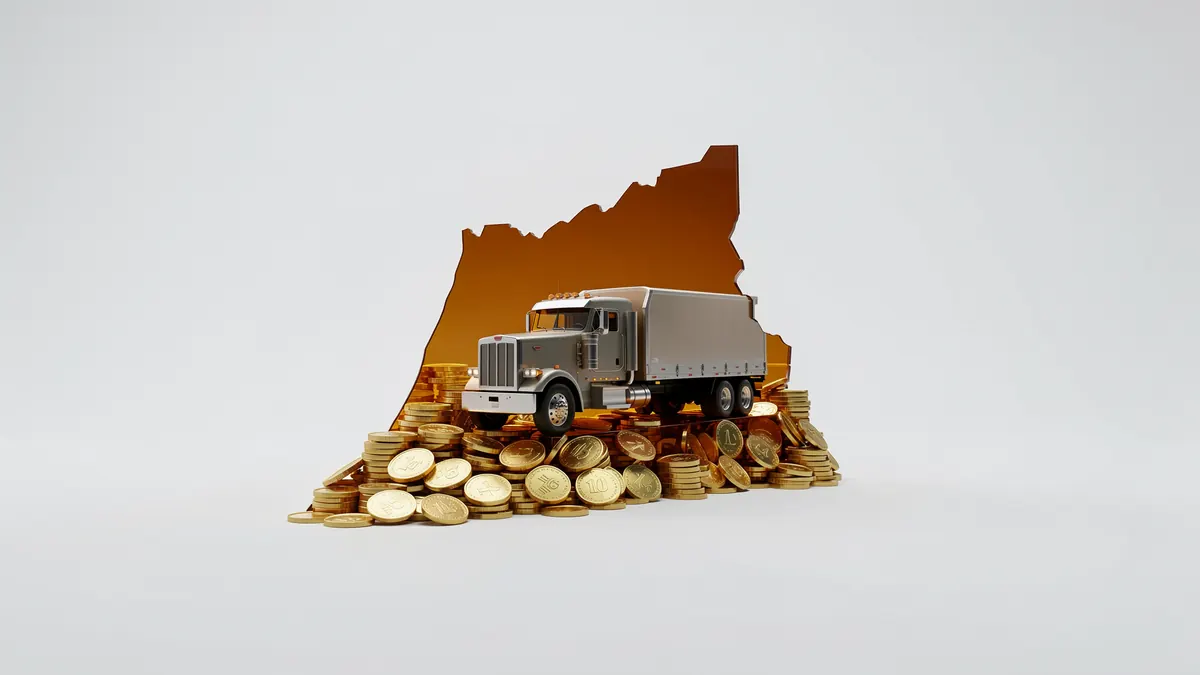
Truck driver pay in Vermont: the numbers
The benchmark is the Bureau of Labor Statistics OEWS survey for heavy and tractor-trailer truck drivers, May 2025 release. Vermont counts roughly 3,560 driver jobs statewide — about 11.7 of every 1,000 jobs — the smallest market in this series, which means every percentile rests on a thin sample and moves more year to year than big-state figures. Annual figures assume 2,080 hours, so treat them as full-time equivalents.
| Metric (SOC 53-3032, statewide) | BLS OEWS, May 2025 | Typical market read (hedged) |
|---|---|---|
| Mean hourly wage | $29.37 | Above the $28.71 national mean |
| Mean annual wage | $61,100 | vs. $59,710 nationally — about $1,390 ahead |
| Median annual wage | $60,830 | vs. the national median of $58,640 — about $2,190 ahead |
| 10th percentile (annual) | $48,900 | An unusually high floor — $8,760 above the national 10th percentile |
| 75th percentile (annual) | $64,900 | Experienced regional work |
| 90th percentile (annual) | $74,700 | A contained ceiling, below the national $79,380 |
| Hedged hiring range, 2026 | — | Roughly $52,000–$68,000 for experienced company drivers; verify with carriers |
Vermont is a narrow-band market: nearly everyone earns between the high $40,000s and mid $70,000s. The 10th percentile of $48,900 is the standout — an entry-level Vermont driver out-earns roughly the bottom quarter of drivers nationally, because a labor-scarce rural state cannot staff trucks at national-floor wages. The trade-off is the ceiling: $74,700 at the 90th percentile trails the national $79,380, and the 75th percentile of $64,900 shows how quickly the ladder flattens. There is simply no large-fleet headquarters economy, big-box DC belt or port complex generating premium volumes of top-end seats. Pay structures lean hourly for local agricultural, construction and manufacturing work, with CPM more common on the New England regional lanes; BLS does not track CPM and carrier offers vary — confirm specifics with the carrier.
How miles and freight shape pay in Vermont
Vermont freight is extractive and agricultural at its root. The state ships out sawlogs, lumber and paper-sector products; milk and dairy feeds a regional food system with substantial refrigerated movement; granite and dimension stone still move from the Barre quarries; and maple, craft food and beverage output punches above its weight. Two corridors carry the load: I-89 runs diagonally from the New Hampshire line through White River Junction and Montpelier to Burlington and the Canadian border gateways, and I-91 runs the eastern side from Massachusetts to Quebec. Both connect Vermont to the metro demand that pays the bills — Boston about 3 hours from the state's center, Albany and Montreal both within reach — so the classic Vermont driver runs regional: out in the morning or on Monday, into a New England metro, back for the reload. Local P&D, tanker milk routes and seasonal logging and construction hauls fill out the mix, and true coast-to-coast OTR is usually run under carriers headquartered well outside the state.
The operational realities are rural ones: slim load selection, long empty legs between small towns, weight-restricted town highways, and a genuine mudseason-to-winter calendar — spring frost heaves and February ice narrow the working year more than any dispatcher admits. Owner-operators should run every sparse-corridor offer through the load profit calculator and price deadhead honestly against their true cost per mile; in a state this small, the difference between a good lane and a bad one is often the return trip. For more state-by-state comparisons, see the truck driver pay by state hub.
The tax angle in Vermont
Vermont taxes wages through a progressive state income tax whose brackets span roughly 3.35% at the bottom to 8.75% at the top, with most middle-income driver wages taxed at effective state rates in the mid-single digits; verify current brackets with the Vermont Department of Taxes. On the $61,100 state mean, a Vermont driver typically sends several thousand dollars a year to Montpelier — a real drag on take-home pay next to no-tax neighbors like New Hampshire, and a key reason wage differentials in northern New England overstate the actual living-standard gap. Drivers who live near a border sometimes base themselves in New Hampshire while running Vermont freight; owner-operators apportion through their base state instead. For deduction basics that apply everywhere, see the trucking tax deductions guide.
FAQ
How much do truck drivers make in Vermont?
Per BLS OEWS (May 2025), heavy and tractor-trailer drivers in Vermont earn a mean of $29.37/hour or $61,100/year, with a median of $60,830 and a 10th–90th percentile spread of $48,900–$74,700.
Is Vermont pay above the national average for CDL drivers?
Yes. Vermont's $61,100 mean runs about $1,390 above the national $59,710, and the 10th percentile of $48,900 is nearly $8,800 above the national entry-level floor.
What freight moves in Vermont?
Forest products and lumber, dairy and food loads, granite and stone from the Barre area, and regional runs connecting the state to Boston, Albany and Montreal via I-89 and I-91.
Does Vermont tax truck driver pay?
Yes — Vermont has a progressive state income tax with rates spanning roughly 3.35% to 8.75%. Most driver incomes land in the middle brackets; verify current rates with the Vermont Department of Taxes.
Is local or OTR work more common in Vermont?
Regional and local dominate. Vermont supports short-haul agricultural and manufacturing runs plus New England regional lanes; true coast-to-coast OTR is usually run for carriers headquartered outside the state.
What per-mile pay can a company driver expect in Vermont?
BLS does not track CPM. Company regional positions in northern New England commonly advertise roughly $0.60–$0.80 per mile; confirm current offers with the carrier.