Truck Driver Pay in North Carolina (2026)
Official BLS numbers for heavy and tractor-trailer drivers (SOC 53-3032) in North Carolina — wages that trail the national mean but ride a fast-growing freight base — plus the I-85/I-40 distribution boom, eastern Carolina ag processing and the state's light flat tax.
By the HaulMath editorial team · Updated $1
Key numbers at a glance
| Metric (SOC 53-3032, statewide) | BLS OEWS, May 2025 | Typical market read (hedged) |
|---|---|---|
| Mean hourly wage | $26.83 | About $1.88 below the $28.71 national mean |
| Mean annual wage | $55,810 | vs. $59,710 nationally — a $3,900 gap |
| Median annual wage | $51,530 | Low-to-mid middle; large OTR carrier presence |
| 10th percentile (annual) | $39,400 | Modest entry floor |
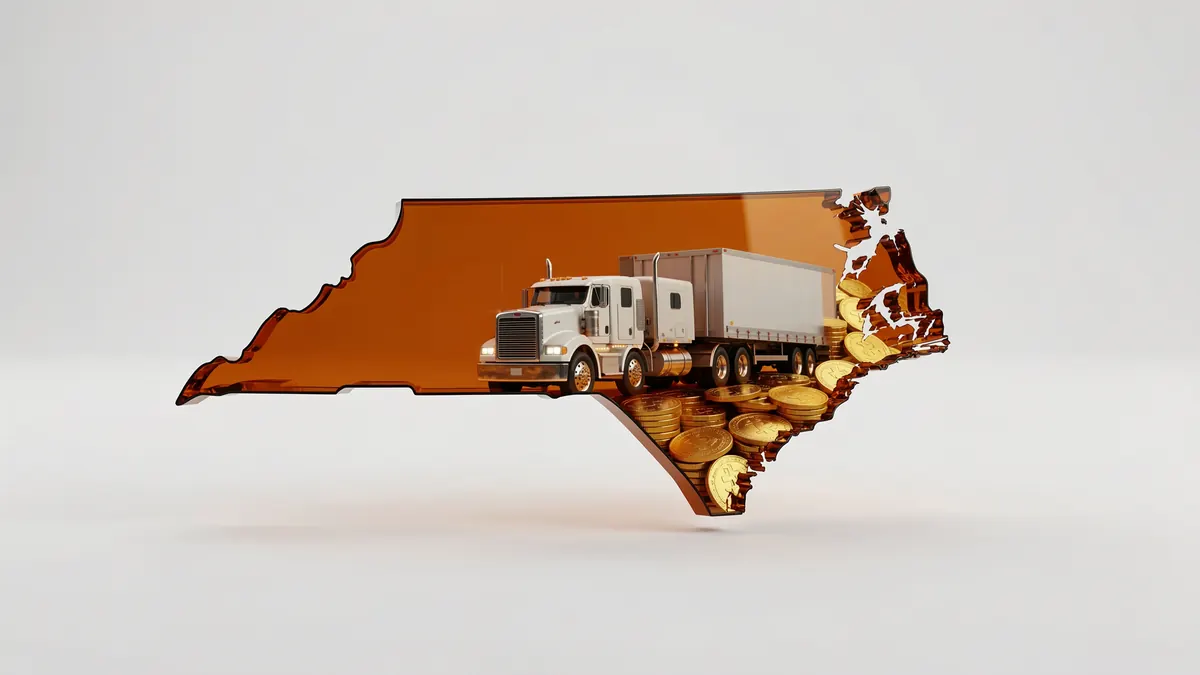
Truck driver pay in North Carolina: the numbers
Figures come from the Bureau of Labor Statistics OEWS survey for heavy and tractor-trailer truck drivers, May 2025 release. North Carolina employs about 62,400 of them — one of the bigger driver populations in this series — and pays a mean of $26.83 an hour, roughly $3,900 a year below the $59,710 national mean. Annual figures assume 2,080 hours.
| Metric (SOC 53-3032, statewide) | BLS OEWS, May 2025 | Typical market read (hedged) |
|---|---|---|
| Mean hourly wage | $26.83 | About $1.88 below the $28.71 national mean |
| Mean annual wage | $55,810 | vs. $59,710 nationally — a $3,900 gap |
| Median annual wage | $51,530 | Low-to-mid middle; large OTR carrier presence |
| 10th percentile (annual) | $39,400 | Modest entry floor |
| 75th percentile (annual) | $62,640 | Dedicated, tanker and experienced regional work |
| 90th percentile (annual) | $76,360 | Healthy ceiling — specialized and private-fleet niches |
| Hedged hiring range, 2026 | — | Roughly $48,000-$66,000 for experienced company drivers; verify with carriers |
The gap between North Carolina's mean ($55,810) and its 90th percentile ($76,360) is wide — about $20,000 — and that's typical of a state where big national OTR carriers set the wage floor with per-mile pay while specialized niches (tanker, heavy haul, private fleets attached to manufacturing) pay well above it. What the statewide mean hides is trajectory: the Piedmont's warehouse build-out has added driving jobs faster than most states, and tight local markets around Charlotte and Raleigh push hourly distribution wages up year after year. BLS does not track CPM; regional and OTR positions commonly advertise roughly $0.58-$0.75 per mile, while local distribution jobs increasingly pay hourly — confirm with carriers.
How miles and freight shape pay in North Carolina
North Carolina sits where I-85 and I-40 cross the Piedmont, with I-95 skirting the east — and the freight map follows. The Charlotte-Raleigh-Greensboro triangle has become one of the Southeast's busiest distribution belts: e-commerce fulfillment centers, grocery and retail distribution, and the FedEx regional hub at Piedmont Triad near Greensboro anchor a large (and growing) pool of local and dedicated driving jobs. Manufacturing adds the specialty freight: the High Point area's furniture industry still moves finished goods nationwide, and the state's plants — aerospace components, autos and machinery in the Piedmont — feed dedicated lanes and private-fleet work. East of I-95 it's agriculture at industrial scale: some of the country's largest hog and poultry processing operations, plus sweet potato, tobacco and grain flows riding to plants and ports, much of it short-radius, hourly tanker and hopper work. At the coast, the Port of Wilmington and the inland Port of Dillon feed container drayage up the I-40 corridor.
Structurally, North Carolina is a genuine three-way market (hedged): regional Southeast runs out of the Piedmont hubs, fast-growing local and dedicated distribution work around the metros, and plenty of national OTR recruiting — the state's large CDL holder base and central East Coast position make it a favorite hunting ground for mega-carriers. For owner-operators, the state's balance of outbound manufacturing and inbound consumer freight means decent lane balance by Southeast standards; still, run every offer through the load profit calculator and pay attention to the fuel surcharge on I-85's stop-start congestion. Compare other states on the truck driver pay by state hub.
The tax angle in North Carolina
North Carolina keeps it simple and light: a flat state income tax — 4.25% for 2025, stepping down to 3.99% for 2026 under the scheduled phase-down (per the NC Department of Revenue's rate schedules, with further cuts triggered by revenue conditions). No local income taxes on wages. That means a $55,810 mean wage loses a bit over $2,200 to the state at 3.99%, which helps close the gap with higher-wage states whose drivers pay two or three times that rate. Owner-operators still owe self-employment tax and should work the trucking tax deductions list, but the state-level picture is about as driver-friendly as income tax gets in the Southeast. Verify current rates with the North Carolina Department of Revenue.
FAQ
How much do truck drivers make in North Carolina?
Per BLS OEWS, May 2025, heavy and tractor-trailer drivers in North Carolina earn a mean of $26.83/hour or $55,810/year, with a median of $51,530 and a 10th-90th percentile spread of $39,400-$76,360 — roughly $3,900 below the $59,710 national mean.
What freight moves in North Carolina?
Distribution and fulfillment around Charlotte, Raleigh and Greensboro, furniture and manufacturing in the Piedmont, hog and poultry processing in the east, and container freight through the Port of Wilmington.
Does North Carolina tax truck driver pay?
Yes — a flat state income tax of 3.99% for 2026, down from 4.25% in 2025. Verify current rates with the NC Department of Revenue.
Is North Carolina a good state for CDL drivers?
Wages run below the national mean ($55,810 vs. $59,710), but the cost of living is low, the flat 3.99% tax is light, and the state's warehouse and distribution build-out keeps local and regional job demand strong.
Is OTR or local work more common in North Carolina?
A real mix: regional Southeast runs are common, local and dedicated distribution work is growing fast with the warehouse build-out, and national OTR carriers recruit heavily in the state.
What per-mile pay can a company driver expect in North Carolina?
BLS does not track CPM. Regional and OTR positions commonly advertise roughly $0.58-$0.75 per mile, and local distribution jobs often pay hourly; confirm with carriers.